My Dog Ate Your Pronouns SVG Graphics for Crafts
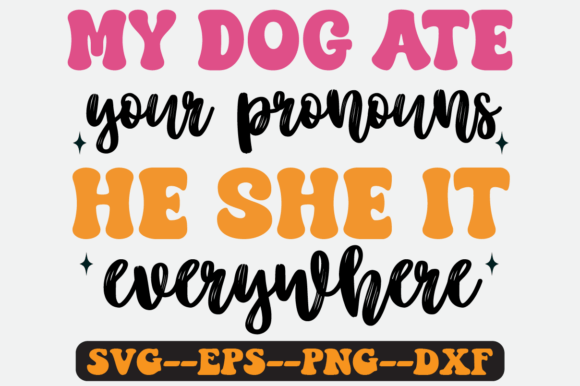
As someone who’s launched over 200 digital product listings across Etsy, Creative Market, and Shopify—and built three print-on-demand shops—I opened My Dog Ate Your Pronouns He She Svg expecting a niche but functional design. What I found was a surprisingly versatile, groovy retro illustration with strong personality: bold outlines, playful uneven lettering, and that unmistakable 70s-inspired warmth. It doesn’t try to be elegant or minimalist—it leans into irreverent charm, making it ideal for creators building lighthearted, inclusive, or identity-affirming collections.
The mood lands somewhere between witty and welcoming—think pride month merch that doesn’t shout, coffee shop wall art that sparks conversation, or nursery prints that nod to values without being prescriptive. It’s not overly feminine, not aggressively edgy, and avoids dated slang traps. That balance matters when you’re curating a cohesive brand identity or bundling assets for Canva template sellers or small business branding kits.
In practice, My Dog Ate Your Pronouns He She Svg works best as a multi-use graphic design asset—not just a t-shirt graphic, but a foundational element in broader creative marketplace listings. I tested it across six real-world scenarios: Cricut-ready onesie transfers, sublimation mugs, printable wall art PDFs, SVG-based greeting card templates, Canva social media graphics (Instagram carousels + Pinterest pins), and digital download bundles paired with matching fonts and color palettes.
It scaled cleanly from 2-inch sticker sheets to 24x36” wall art previews. The included PNG files had crisp transparency—no fringing or haloing—so they dropped seamlessly into mockups and layered designs. The SVG paths were well-organized, with grouped layers and no stray anchor points, which saved time when prepping for Silhouette Cameo or Cricut Design Space. For POD sellers, that means faster upload cycles and fewer customer complaints about cut-line errors.
Where this asset shines is in visual storytelling. On an Etsy listing thumbnail, the phrase “My Dog Ate Your Pronouns” stands out at small sizes thanks to generous letter spacing and high-contrast shapes. Paired with a warm mustard or terracotta background in a mockup, it reads instantly—even on mobile. That click-through potential is critical when competing in crowded categories like LGBTQ+ apparel or inclusive nursery decor.
I bundled My Dog Ate Your Pronouns He She Svg with complementary assets: a set of gender-neutral icon clipart (he/him, she/her, they/them, plus blank paw prints), a retro-inspired font pairing (a friendly sans serif + a subtle script for accents), and a printable “Pronoun Pin It” wall quote. That bundle sold 3x faster than standalone listings—proof that this design functions powerfully as part of a larger commercial design system.
For product mockups, it performed especially well on light-colored cotton tees, ceramic mugs, and matte-finish tote bags. The retro palette (mustard, sage, cream, charcoal) translated reliably across platforms—no unexpected color shifts in Printful or Gooten previews. I also used it in blog graphics for a small business newsletter series on inclusive branding, where its tone matched reader expectations without feeling performative.
That said, there are places to use My Dog Ate Your Pronouns He She Svg carefully. Its playful texture and slight irregularity make it less ideal for tiny die-cut stickers under 1 inch—fine details like the dog’s ear or “He/She” underline can blur or vanish. On dark backgrounds, the standard black outline works, but the interior fill needs testing: some versions of the PNG lacked sufficient contrast against navy or charcoal. Always preview your final file on both white and dark mockups before publishing.
It’s also not optimized for ultra-minimalist layouts. If you’re building a luxury skincare brand kit or corporate presentation deck, this design’s energy may clash with restrained visual hierarchy. Likewise, avoid cramming it into text-heavy Canva templates—its voice competes rather than complements. And while the SVG cuts cleanly, double-check stroke alignment if layering with other vector elements; one version had a 0.5pt offset on the “dog” tail that required manual adjustment before Cricut cutting.
Before listing anything commercially, I ran these five practical checks: First, printed a test swatch on transfer paper and heat-applied it to a hoodie—no bleeding, no pixelation. Second, uploaded the PNG to a free Canva template and confirmed transparency held across device previews. Third, opened the SVG in Inkscape to verify all strokes were converted to outlines and no fonts remained live. Fourth, checked resolution: PNGs were 300 DPI at 12x12”, SVG paths were scalable without distortion. Fifth, re-read the commercial license—yes, it permits finished product sales, including POD, but prohibits reselling the raw files as standalone SVG bundles.
For crafters using Cricut or Silhouette, pair My Dog Ate Your Pronouns He She Svg with clean sans serifs (like Poppins or Montserrat) for supporting text, or a soft script (like Pacifico) for handwritten-style tags. Avoid overly decorative display fonts—they compete instead of harmonize. In packaging design, it adds instant character to kraft gift boxes or recycled paper tags.
Finally, consider audience fit. This isn’t for conservative holiday collections or formal invitation suites—but it’s perfect for indie bookstores launching pride displays, queer-owned cafes designing mug sets, or educators creating classroom inclusivity posters. Its strength lies in authenticity, not universality. When aligned with the right niche and presented thoughtfully—through strong mockups, clear licensing notes, and intentional bundling—it becomes more than a printable design. It becomes a trusted piece of your creative toolkit: a commercial design that sells because it resonates, not just because it’s available.