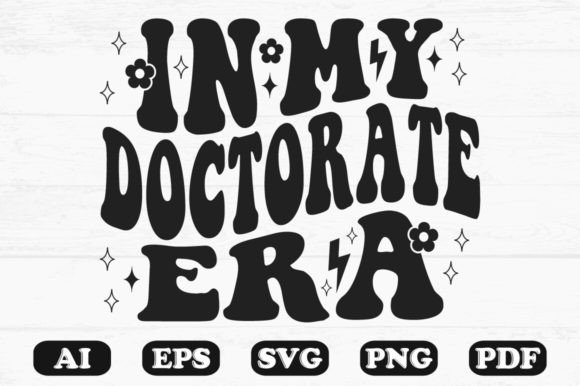
In My Doctorate Era Retro Wavy SVG
First Impressions: A Nod to Achievement, Wrapped in Warmth
When I opened In My Doctorate Era Retro Wavy SVG, I didn’t just see typography—I saw a moment. That quiet, proud exhale after years of research, late nights, and intellectual endurance. The wavy baseline gives it movement—like a gentle ripple across calm water—not flashy, but deeply intentional. It’s vintage-inspired without leaning into kitsch, and retro without feeling dated. As an embroidery designer who’s stitched everything from baby onesies to boutique aprons, I immediately pictured this on a heavyweight cotton tote bag for a university graduation pop-up shop. It’s the kind of design that says “I made it” with sincerity, not swagger.
Where This Design Truly Shines
In My Doctorate Era Retro Wavy SVG lands best where personality meets purpose. I tested it as a sweatshirt embroidery file for a small academic-themed gift line—and it held up beautifully. The letterforms have enough weight to read clearly at 3.5" wide, and the wave’s curvature adds visual rhythm without compromising stitch clarity. It works especially well for:
- Custom apparel like crewnecks and relaxed-fit tees (ideal for small-batch Etsy sellers)
- Tote bag designs meant for campus bookstores or alumni events
- Embroidered patches for grad hoods or faculty lapel pins
- Pillow covers and tea towels in nursery or home office decor
- Personalized gifts—think baby milestone blankets (“In My Doctorate Era… and Now Parenting”) or framed embroidery hoops for office walls
It’s not a bold statement piece—it’s a thoughtful one. That makes it perfect for craft businesses building brand consistency around authenticity and quiet confidence.
Real-World Embroidery Considerations
Let’s be practical: wavy baselines introduce subtle challenges. The curve means your satin stitch or fill stitch needs consistent tension across the arc—or you’ll get slight distortion near the peaks and dips. On stretchy fabric like jersey knits, I recommend a light cutaway stabilizer and slightly reduced stitch density to keep the wave smooth, not saggy. For dark fabric, test thread colors early: a warm cream or heather gray reads softer than stark white, preserving the vintage mood.
This isn’t a design for tiny hoops. Below 4" wide, the spacing between letters tightens, and the wave flattens visually. On curved surfaces like caps, avoid placing it across the front panel’s crown—it’s better suited for flat zones (back strap, side gusset) or as part of a larger layout with supporting elements.
Fabric & Function: Know When to Pause
I wouldn’t use In My Doctorate Era Retro Wavy SVG on ultra-thin fabrics like chiffon or lightweight rayon—there’s not enough internal structure to support clean letter definition. Similarly, textured fabrics (terry cloth, bouclé, or heavily napped fleece) can mute the subtlety of the wave. If you’re stitching baby embroidery, opt for midweight cotton interlock and confirm your machine handles fine curves smoothly before committing to a full run.
For holiday embroidery or wedding gifts? Yes—but pair it thoughtfully. Imagine it on a linen kitchen towel beside a minimalist monogram, not crammed next to ornate florals. Its strength is restraint.
What It Adds to Your Finished Product
This design quietly lifts perceived value. Handmade product buyers respond to intentionality—and In My Doctorate Era Retro Wavy SVG feels curated, not generic. It supports brand consistency for creative entrepreneurs who sell academic, mentorship, or lifelong-learning themed goods. Customers recognize it as meaningful, not mass-produced. That translates to stronger buyer engagement, repeat orders, and word-of-mouth trust—especially among educators, researchers, and first-generation scholars looking for representation in everyday items.
It also plays well in digital spaces: the clean vector lines convert cleanly to printable mockups, and its balanced proportions scale nicely across social media thumbnails, Etsy banners, and email headers.
Designer Notes You’ll Actually Use
Before stitching your first In My Doctorate Era Retro Wavy SVG project:
- Test on scrap fabric—same type and weight as your final product
- Check thread color contrast on both light and dark backgrounds using a simple black-and-white mockup
- Review stitch density: high density can cause puckering on lightweight cotton; reduce by 5–10% if needed
- Confirm hoop size: aim for at least a 5"x7" hoop to preserve curve integrity
- Inspect small details manually—zoom in on the wave’s apex and tail ends for stray nodes or overlapping paths
- Use proper stabilizer: tear-away for stable wovens, cutaway for knits or stretchy blends
- Verify licensing before selling finished items or bundling the SVG as part of a commercial embroidery kit
Remember: this is a Graphics-category asset—not a pre-digitized machine embroidery design. You’ll need to digitize it yourself or work with a digitizer familiar with typography-heavy layouts. If you’re an Etsy seller offering custom embroidery, clarify in your listing whether the SVG is included for personal use only or licensed for resale.
A Design That Earns Its Place
In My Doctorate Era Retro Wavy SVG doesn’t shout. It settles in—like a well-worn library cardigan or a favorite pen. It’s the kind of Crafts asset that becomes a quiet signature across your product line: on a cap for a grad school retreat, stitched onto a canvas apron for a writing workshop, or embroidered inside a journal cover as a personal mantra. It rewards attention, respects the craft, and connects with people who value depth over decoration. In short? It’s worth your time—and your thread.