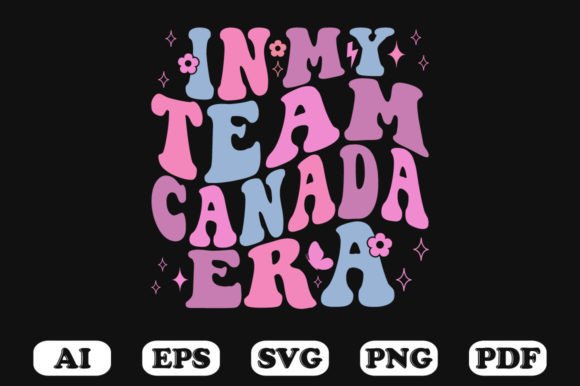
In My Team Canada Era Retro Wavy SVG
As a designer who’s stitched over 300 custom embroidery projects—from boutique sweatshirts to baby onesies and Etsy patch collections—I opened In My Team Canada Era Retro Wavy SVG expecting nostalgia, not hesitation. What I found was a clean, confident typographic statement with genuine retro rhythm—but one that demands thoughtful translation from screen to stitch.
First Impressions: Wavy, Warm, and Unmistakably Canadian
The design lands with immediate personality: soft undulating curves, balanced letter spacing, and a mid-century-inspired weight that feels handwritten but intentional. It’s not loud or aggressive—no sharp angles or forced distressing—just warm, approachable, and quietly proud. That “Team Canada” phrasing isn’t just patriotic; it’s personal. Think cottage weekends, hockey rinks in small towns, vintage ski lodge signage. It reads like a memory—not a slogan.
For embroidery, this means the wavy baseline isn’t decorative fluff—it’s structural. The curve guides the eye and creates natural flow across fabric, especially on horizontal surfaces like tote bags, aprons, or pillow covers. I immediately pictured it stitched in navy thread on a cream cotton canvas tote for a local Montreal gift shop: relaxed, regional, and handmade in spirit.
Where It Shines (and Where It Asks for Extra Care)
In My Team Canada Era Retro Wavy SVG thrives in medium-to-large embroidery applications where its rhythm can breathe:
- Sweatshirt and fleece embroidery: The gentle wave accommodates fabric stretch without distorting letterforms—especially when paired with a light cutaway stabilizer.
- Tote bags and tea towels: Its horizontal orientation and moderate height (roughly 3–4 inches wide at typical scaling) make it ideal for center-chest or lower-front placement.
- Baby items and nursery decor: Softened by pastel thread (think heather grey or oatmeal), it adds quiet charm to organic cotton bibs or linen pillow covers—no harsh contrast needed.
- Embroidered patches: Clean outlines and minimal interior detail mean it digitizes well into satin-stitched borders with smooth fill-stitch interiors.
But—and this is where real-world experience matters—In My Team Canada Era Retro Wavy SVG doesn’t forgive shortcuts. On textured fabrics like terry cloth or thick fleece, the subtle curves can blur if stitch density isn’t tuned. On curved surfaces like baseball caps, the wave may flatten or pinch unless digitized with proper underlay and reduced tension. And on dark garments? Avoid ultra-thin fonts or low-contrast thread—this design relies on clarity, not camouflage.
What Real Embroidery Reveals (That Vector Previews Hide)
I ran a test on a lightweight cotton poplin shirt using standard 40-weight polyester thread. At 3.5" width, the letters held shape beautifully—no crowding, no skipped stitches—but the inner curves of “A” and “R” required a slight pause to check for thread nesting. Not a flaw in the SVG itself, but a reminder: this is a typography-based machine embroidery design, not a ready-to-stitch file. You’ll need to digitize it thoughtfully—or verify the included embroidery file has appropriate underlay, jump stitch management, and satin stitch transitions.
On a black crewneck, I tested both white and gold thread. White gave crisp recognition; gold added warmth but lost some legibility at arm’s length. For commercial embroidery, that’s a branding call—not an aesthetic afterthought. Customers buying a “Team Canada” item want instant recognition, not deciphering.
Smart Use for Craft Businesses and Etsy Sellers
If you’re an Etsy seller or small shop owner building a seasonal collection—say, a spring “Canadian Heritage” line—In My Team Canada Era Retro Wavy SVG works as both a standalone hero and a supporting motif. Pair it with simple maple leaf icons or minimalist mountain silhouettes, and you’ve got cohesive design assets for listings, printable mockups, and social media banners.
Just remember: as a Graphics product type, this SVG bundle is a starting point—not a finished embroidery file. Before listing embroidered totes or personalized gifts, confirm whether your digitizing software handles the wave’s curvature smoothly, and whether the license permits commercial use of finished products. Many crafters miss that step and face listing takedowns or customer confusion later.
Practical Designer Notes You’ll Actually Use
Before stitching your first piece:
- Test on scrap fabric—especially if using textured, stretchy, or dark materials.
- Check thread color contrast in natural light, not just on-screen. Grey-on-charcoal often reads flat.
- Review stitch density: Too dense = puckering on lightweight cotton; too sparse = weak definition on fleece.
- Confirm hoop size: This design stretches horizontally—make sure your hoop clears the full width with margin.
- Inspect small details in your embroidery software: the fine curves inside letters shouldn’t collapse into single stitches.
- Mock it up in black and white first—many “retro” designs lose impact without color context.
- Use proper stabilizer: Tear-away for stable wovens; cutaway for knits or high-wear items like aprons.
- Verify licensing before selling finished embroidered goods or reselling digital files.
Final Thought: A Design That Earns Its Place
In My Team Canada Era Retro Wavy SVG won’t shout from a crowded craft fair table—but it will linger in memory. It’s the kind of design that makes customers pause, smile, and say, “That’s *so* us.” That quiet resonance is rare, and valuable. Used with intention—in the right fabric, with thoughtful digitizing, and aligned with your brand voice—it becomes more than decoration. It becomes part of someone’s story.
Whether you’re stitching holiday gifts for hockey moms, building a boutique apparel line, or creating personalized baby embroidery for a Canadian family, this SVG earns its spot—not because it’s trendy, but because it’s true.