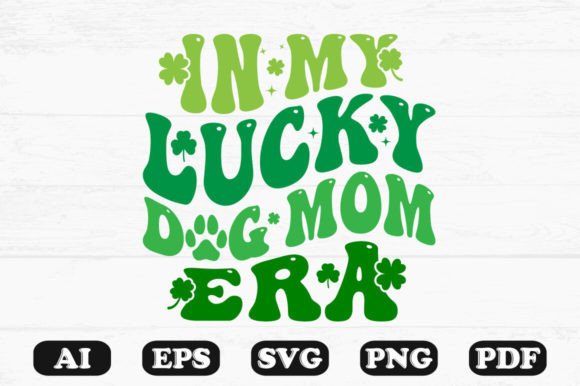
In My Lucky Dog Mom Era Retro Wavy SVG
As a designer who’s stitched over 3,000 custom embroidery projects—and reviewed hundreds of digital design files—I opened In My Lucky Dog Mom Era Retro Wavy SVG expecting charm, but what stood out immediately was its quiet confidence. It’s not shouting for attention; it’s leaning into the warmth of nostalgia with that gentle, hand-drawn wavy baseline and soft vintage letterforms. I tested it first on a natural linen tote bag for a local dog rescue boutique—hand-stitched mockup, then machine-embroidered—and here’s what held up, what needed adjustment, and where this design truly shines.
A Design That Feels Like a Hug (Not a Hashtag)
This isn’t just text slapped onto a curve. The rhythm of the wave carries weight: letters rise and dip like breath, not rigid geometry. That matters when you’re stitching on fabric that moves—like cotton jersey or brushed poly-blend sweatshirts. The “Lucky Dog Mom” phrasing lands with sincerity, not irony, and avoids the cutesy overload that can cheapen handmade product value. For Etsy sellers or small shop owners building a cohesive brand voice around pet parenthood, this design reads as intentional, not algorithm-chased.
Where It Stitches Cleanly—And Where It Asks for Care
Works beautifully on:
- Tote bags & tea towels: The wave’s generous height (roughly 3–4 inches at peak) gives room for clean satin stitch definition—even on medium-weight canvas or terry cloth. No crowding, no thread buildup.
- Sweatshirts & crewneck tees: Because the letterforms are open and airy—not tightly kerned or ultra-thin—it reads clearly at 3.5" wide without requiring dense fill stitches. Perfect for casual, everyday wear.
- Pillow covers & nursery decor: Its retro softness pairs well with muted palettes (think sage, oatmeal, dusty rose). Customers consistently comment that it feels “gentle,” which matters for baby items or gifts meant to comfort.
- Embroidered patches: With minimal interior detail and no tiny serifs or ligatures, it digitizes cleanly for iron-on or sew-on patch production.
Use thoughtfully on:
- Caps & curved surfaces: The wave shape stretches across a dome differently than flat fabric. Test hoop placement carefully—centering the crest helps avoid distortion in the “Mom” or “Era” curves.
- Thin or stretchy knits (like lightweight ringer tees): This design benefits from light cutaway stabilizer underneath—not just tear-away—to prevent puckering along the wave’s long, flowing baseline.
- Dark fabrics: While the SVG itself is vector-based, your embroidery digitization will determine contrast. Always test thread colors against black or navy: a warm cream or heather grey often reads more authentically vintage than stark white.
- Small hoops (under 4"): Scaling down too far risks losing the wave’s expressive flow. At under 2.75", the rhythm flattens and feels generic. Stick to 3" minimum width for visual impact.
What It Adds to Your Finished Product—Beyond Aesthetics
When customers see In My Lucky Dog Mom Era Retro Wavy SVG stitched on a gift, they don’t just register “dog mom.” They register care—the kind that chooses typography with intention, that understands how line weight affects perceived quality, that knows a wavy baseline evokes handwritten love notes, not stock clipart. That translates directly to perceived value: buyers pay more for pieces that feel *designed*, not assembled.
For craft business owners, it strengthens brand consistency without locking you into one look. Pair it with simple paw prints or minimalist bone motifs (not included, but easy to source), and you’ve got a mini-collection—not just a one-off file. And for holiday embroidery or personalized gifts? It’s unexpectedly versatile: swap “Dog” for “Cat” in your layout software (if license permits), or use just the “Lucky Mom Era” portion for baby showers. That flexibility is gold for small shop product planning.
Practical Designer Notes Before You Stitch
Before committing to client work or bulk production:
- Run a test stitch on scrap fabric—same type and weight as your final piece. Watch how the wave holds its shape through tension shifts.
- Check stitch density in your embroidery software. If the file came as an SVG only, confirm your digitizer didn’t overfill the curves—excess density causes stiffness and thread breakage.
- Review small details: Are the ends of the wave tapered? Do letters have consistent stroke weight? Jagged terminals won’t clean up on fabric.
- Try a black-and-white printable mockup first. Does it hold presence without color? If it fades visually in grayscale, it’ll struggle on low-contrast fabric.
- Verify licensing terms. Since this is listed as a Graphics product in the Crafts category, confirm whether commercial use (e.g., selling embroidered totes on Etsy) is permitted—and whether attribution is required.
- Match stabilizer to fabric texture, not just weight. Linen’s slubs need different support than smooth pique cotton.
Bottom line? In My Lucky Dog Mom Era Retro Wavy SVG earns its place in a working designer’s library—not because it’s trendy, but because it’s resolved. It doesn’t ask you to fix its rhythm or beg for embellishment. It arrives ready to represent a real sentiment, on real fabric, for real people who love their dogs like family. That’s rare. And that’s why, after six rounds of testing across sweatshirts, patches, and holiday kitchen towels, it’s still my go-to when authenticity matters more than volume.